
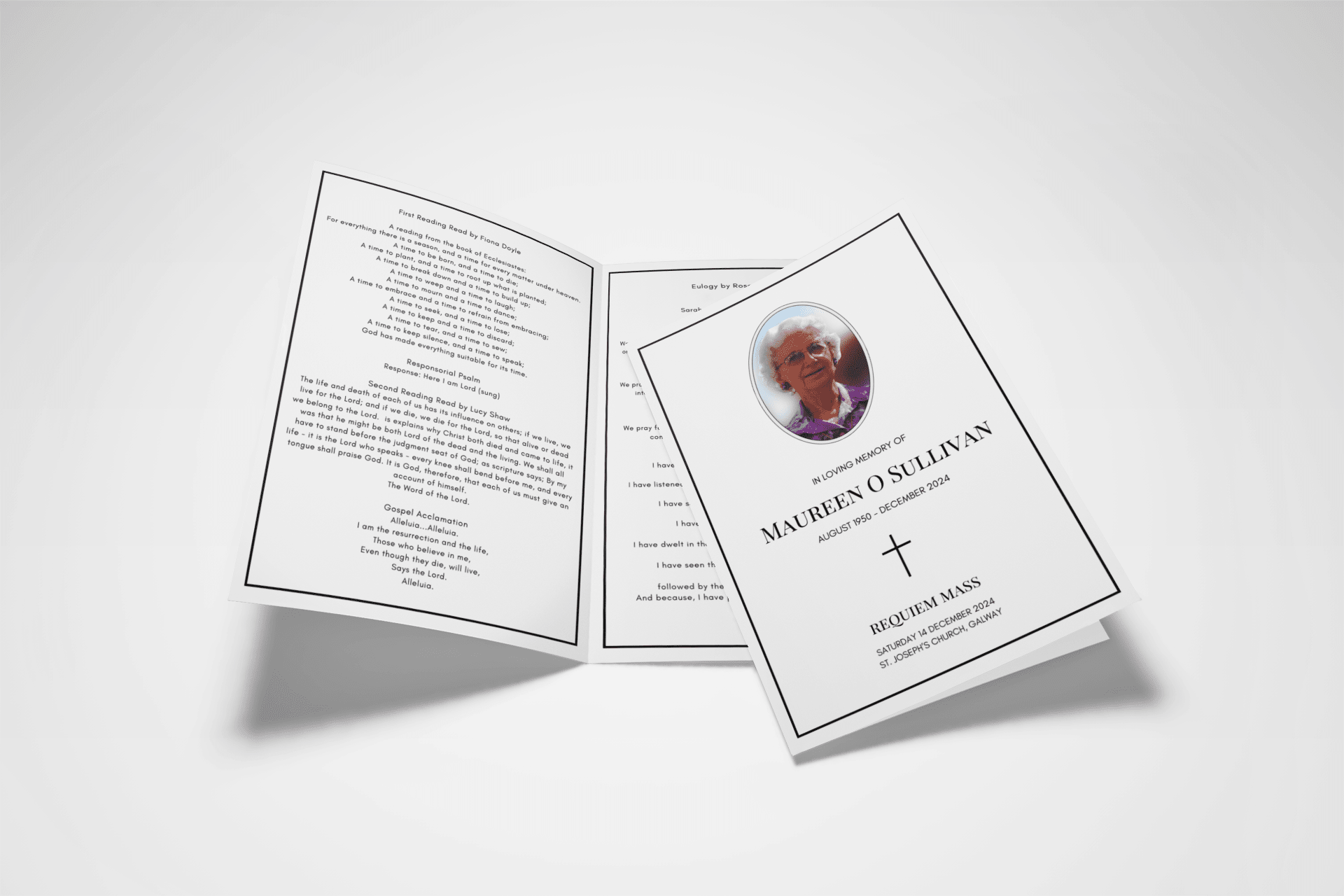
Planning memorial and funeral stationery can feel daunting on a hard day. Small details matter, and gentle guidance helps. This article gathers practical advice on wording, photos, timelines, proofing and paper choices so you can create keepsakes that feel right for your family.
At JayCee in Galway, families often arrive with a favourite photo and a few lines. We help shape that into a complete set of pieces that look consistent and read clearly. Whether you order online nationwide or visit in-store, the aim is the same, a respectful result with steady support.
If you are unsure where to start, use the sections below as a checklist. Take it one step at a time.
What goes into each piece
Memorial and funeral stationery usually includes one or more of the following. You can choose a single item or a coordinated suite.
-
Memorial cards: Folded or flat cards with a photo, name, dates, short verse or prayer, and sometimes a back panel for a blessing.
-
Wallet cards: Small keepsakes for purses and wallets. One photo, name, dates, and a short line. Durable when laminated.
-
Bookmarks: Tall format with a portrait photo, a favourite poem or prayer, and a simple design that matches the card.
-
Acknowledgement cards: Sent by the family after the funeral to thank those who supported them. Space for a personal note or a printed message.
-
Funeral booklets: Also called orders of service. Include the ceremony outline, readings, hymns or songs, photos, and thank-you details. Stapled for neat handling.
If you prefer to browse options, you can view memorial cards and matching bookmarks on our website. For longer services, see our funeral booklets guidance and examples.
-
Browse memorial cards: a range of designs, photos and verses, with recycled paper options available (https://www.jaycee.ie/collections/memoriam-cards)
-
View memorial bookmarks: coordinated layouts with space for a short verse (https://www.jaycee.ie/collections/memorial-bookmarks)
-
Explore funeral booklets: layout help, stapled finish, and fast turnaround where possible (https://www.jaycee.ie/collections/funeral-booklets/funeral-ceremony)
Wording basics and gentle examples
What do you say in a memorial card? Keep it short, clear and personal. Include:
-
Full name and nickname if used in life.
-
Dates of birth and death, or simply the years.
-
A short quote, prayer or blessing.
-
Optional line about family, place, or a hobby that captures the person.
What is usually on a memorial card? A portrait photo, name, dates, a brief verse, and sometimes a background image meaningful to the person, for example a seascape, local landscape or a simple cross.
Who gets a memorial card? Typically close family, friends, neighbours, and anyone who supported the family. Many people hand them out at the funeral and keep some for posting later to relatives abroad.
How do I end a memorial card? Finish with a closing line that feels natural, for example:
-
Rest in peace.
-
Forever in our hearts.
-
Ar dheis Dé go raibh a anam.
What is a short quote for a memorial card? A few options:
-
“Those we love do not go away, they walk beside us every day.”
-
“May the road rise to meet you, may the wind be always at your back.”
-
“Gone from our sight, but never from our hearts.”
How to write a memorial quote? Choose one idea, keep it under two or three lines, avoid complex words, and read it aloud. If it sounds gentle and true for the person, it will work on paper.
Short Irish blessings many families choose:
-
“Ar dheis Dé go raibh a anam” or “Ar dheis Dé go raibh a hanam dílis” for a woman.
-
“Until we meet again, may God hold you in the palm of His hand.”
Preparing photos that print beautifully
A clear photo lifts the whole design. Aim for:
-
Resolution: 300 dpi at final print size. As a guide, a 1200 x 1800 pixel image prints well at postcard size.
-
File type: JPEG or PNG from a phone or camera works. Avoid screenshots from social media to prevent blur.
-
Cropping: Leave space around the head and shoulders. Designers can crop to fit.
-
Old prints: Bring originals in-store for careful scanning. Staff can scan at high resolution, reduce dust and scratches, and advise on gentle retouching.
-
Retouch considerations: Light colour correction, remove minor marks, tidy backgrounds. Keep features natural so the person still looks like themselves.
If you are preparing several images for a booklet, label them with simple filenames such as “Cover”, “Inside-1”, “Back” to help with layout. If you need prints for frames at home or the church, our photo printing service can produce matching enlargements with consistent tones (https://www.jaycee.ie/photo-printing).
Timelines and fast-turnaround choices
Every family moves at a different pace. Typical timelines:
-
Memorial cards, wallet cards, bookmarks: 2 to 5 working days after proof approval in normal periods. Faster options are often possible for small quantities.
-
Acknowledgement cards: usually ordered after the funeral, within a few weeks.
-
Funeral booklets: artwork prepared as readings are finalised. Printing and stapling typically completed 1 to 2 working days after a signed-off proof, with rush support where possible.
Busy seasons can add days. If you need same or next day for a small job, call the shop in Galway during opening hours. Staff will advise on what is realistic that day and suggest alternatives if needed.
Proofing steps that prevent errors
Proof carefully before print. A quiet 10 minutes now saves stress later.
-
Check names, dates and spellings against official documents.
-
Read quotes aloud to catch missing words or punctuation.
-
Confirm photo choice, crop and background.
-
Verify quantities and delivery details.
-
Ask one other family member to review. A second set of eyes helps.
When you receive a digital proof, view it on a larger screen if possible. If you are in Galway, you can review a sample in-store. Once approved, changes are limited, so take your time.
Paper, finish and recycled options
Paper choices set the tone:
-
Silk or satin card: soft sheen, crisp photos.
-
Matt card: modern, non-glare finish, easy to read.
-
Textured stocks: subtle pattern for a traditional feel.
-
Recycled options: responsibly made papers available in several weights.
Finishes:
-
Lamination on wallet cards for durability.
-
Stapled finish on booklets for tidy handling.
-
Rounded corners for a softer look.
If you are unsure, ask for guidance on the best stock for photos and for writing with a pen on acknowledgement cards. For simple folded or flat pieces outside memorial items, our flat card printing and folded card printing pages outline sizes and finishes often used across personal stationery:
-
Flat card printing options and sizes (https://www.jaycee.ie/products/flat-card-printing)
-
Folded card printing options and sizes (https://www.jaycee.ie/products/folded-card-printing)
Ordering online or in-store, with support
Two easy channels:
-
Online nationwide: upload photos and wording, choose quantities, and request recycled paper if you wish. Free nationwide delivery is available on qualifying web orders over the referenced promotional threshold shown on the site.
-
In-store Galway: 34 Upper Abbeygate Street, Monday to Friday 10:00 to 17:00. Staff can scan originals, advise on wording, and prepare proofs. If you prefer, our team can manage the whole process while you review and approve.
Promotions run from time to time, for example 10% off memorial stationery. Availability varies. Check the website or call to confirm current offers.
Quick wording templates you can adapt
Use these as starting points and edit to reflect your loved one.
-
Simple and classic: In Loving Memory of Mary O’Connor 12 March 1943 - 2 June 2024 Forever in our hearts
-
With an Irish blessing: In Loving Memory of Seán Murphy 1948 - 2024 “May the road rise to meet you, may the wind be always at your back.”
-
Religious: In Loving Memory of Nora Kelly 1936 - 2024 Ar dheis Dé go raibh a hanam dílis
-
Acknowledgement card message: The family of Patrick Daly thank you sincerely for your kindness and support. Your prayers, calls and messages have brought great comfort. Please accept this as a token of our gratitude.
FAQ
-
What do you say in a memorial card? A short line that names the person, shows dates, and includes a brief quote or blessing. Keep it genuine and simple.
-
What is usually on a memorial card? A portrait photo, full name, dates, and a short verse or prayer. Some families add a background image that holds meaning.
-
What is a short quote for a memorial card? “Those we love do not go away, they walk beside us every day.” For an Irish option, “Ar dheis Dé go raibh a anam.”
-
Who receives memorial cards? Close family and friends, neighbours, and anyone who offered support. Many are shared at the funeral and posted later to relatives abroad.
-
How do I end a memorial card? Close with “Rest in peace,” “Forever in our hearts,” or an Irish blessing.
-
How do I write a memorial quote? Choose one idea, keep it to one or two lines, read it aloud, and avoid complicated phrasing.
Summary and next step
Memorial stationery works best when the essentials are clear, the photo is sharp, and the wording feels true to the person. Start with name, dates and one short quote. Choose a paper that suits your style, review a careful proof, and allow time where possible, with rush support when needed.
If you would like quiet, steady help, you can order memorial cards and matching pieces online or call into our Galway shop. Our team will guide wording, scan photos, and prepare neat, respectful prints that your family can keep and share.